
Water Sort: Color Match
FunForge StudiosCasual
4.8507.00 Reviews
- Version
- 1.1.9
- Installs
- 5.00M
- Age Rating
- Everyone
Screenshots
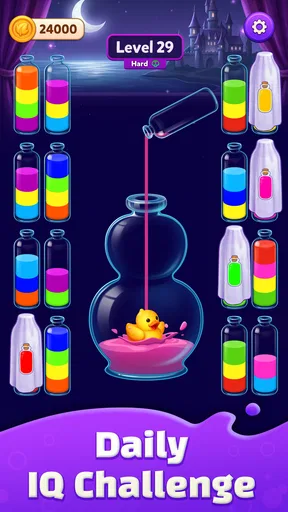
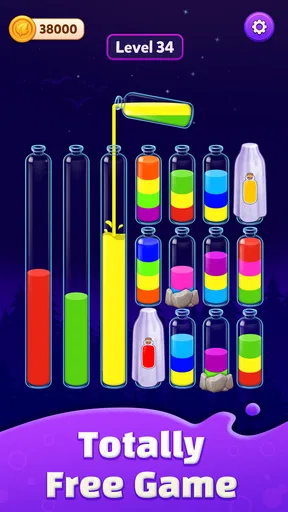
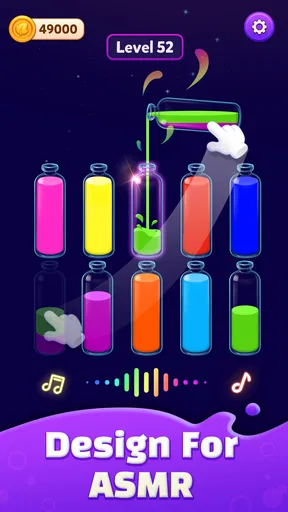
Our Review of Water Sort: Color Match
 Analysis by Appyee
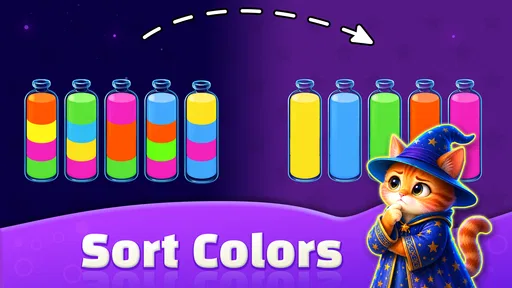
I spent time with Water Sort: Color Match as a quiet, pick-up-and-play puzzle rather than something designed to dominate my attention. The central idea is easy to understand: colored liquid sits in separate containers, and I pour it from one tube to another until matching colors are grouped together. That simplicity is the reason the game is approachable, but it also means the quality of the experience depends heavily on how well each puzzle creates a meaningful decision instead of becoming a routine sequence of taps.
FunForge Studios presents this as a casual game for everyone, and that description fits my experience. It is free to start, available for devices running Android 6.0 or later, and the current version is 1.1.5. The game has reached over one million installs and holds a 4.8 average from around forty-two thousand ratings, so it has clearly found a broad audience. I can understand why: the rules are almost instantly readable, the theme is gentle, and a single level can fit into a short break without demanding a large time commitment.
How the puzzle builds goals, progress, and pressure
I find the most useful way to judge a sorting puzzle is to separate a satisfying finish from genuine progress: a board can look tidier while leaving its buried colors harder to reach. I pay attention to whether each move creates new options, not just whether it completes an obvious match. That distinction also helps me decide how much effort a puzzle deserves, which leads naturally to the question of what its goals and pacing ask from the player.
The first goals are clear, but the real objective is planning
The early appeal comes from having a goal that needs no tutorial essay. I look at the containers, identify the color layers, and begin deciding which pour will open the next useful move. Every action changes the available space, so even a basic board gives me a small planning problem. The immediate target is to bring like colors together, but the practical target is to avoid filling a container in a way that blocks the colors underneath.
That distinction matters. A beginner can play by matching the most obvious color, while a more careful player starts asking what the board will look like two or three moves later. I found that the spare container, when available in a puzzle, is not simply an empty place to dump liquid. It works more like temporary working space. Using it too early can leave me with no room when a deeper layer needs to be exposed, while saving it too long can make the opening position unnecessarily crowded.
This creates an early goal beyond “finish the level”: preserve options. I recommend treating empty space as a resource rather than as a convenient parking spot. If I have two possible pours, I usually prefer the one that reveals a buried color or keeps a second container flexible. That small habit makes the game feel more thoughtful without making it inaccessible.
Progress is visible through board control rather than elaborate rewards
What kept me moving from one puzzle to the next was the visual sense of order returning to the board. A messy arrangement gradually becomes a set of completed color groups, and that transformation is a satisfying progress signal in itself. The game does not need a complicated narrative to communicate success; the state of the containers tells me immediately whether my decisions are working.
This is also where the pacing feels strongest. A successful pour can expose a new layer, which creates a fresh short-term objective. I am not merely repeating the same action until the screen changes. I am repeatedly reducing uncertainty: first I identify a safe move, then I create space, then I use that space to finish a color. The best boards make those stages feel connected.
For players who need a strong sense of long-term advancement, the experience may feel lighter. The satisfaction is concentrated in solving the current arrangement, not in building a character, collecting a large inventory, or following a story. I see that as a deliberate fit for a casual puzzle, but it is worth knowing before installing it. This is a game for people who enjoy local, self-contained victories more than extensive meta-progression.
The difficulty curve comes from mistakes, not complicated rules
The rules remain simple as the mental demand increases. Difficulty comes from the order of the colors, the amount of temporary space, and the consequences of pouring into the wrong container. A move that looks harmless can trap a useful layer beneath another color. When that happens, I have to rethink the whole arrangement rather than simply continue matching whatever is nearest.
I like this kind of difficulty because it rewards observation more than fast reactions. There is no need to tap quickly or memorize a large control scheme. The challenge is deciding whether a move improves the position. That makes the game suitable for a short evening session, a commute, or a few minutes while waiting, especially for players who prefer calm concentration to reflex-based play.
Still, the same structure can become frustrating for anyone who dislikes undoing work. When I make a poor early decision, the board may remain technically playable but become much harder to untangle. My practical advice is to pause before the first pour and scan the top layers of every container. Look for colors that can be combined immediately, but also notice which containers are hiding colors that will need access later. That brief inspection prevents many avoidable dead ends.
Why the pacing works in short sessions
The game’s natural rhythm is built around small decisions. I can begin a puzzle without preparing for a long session, make meaningful progress within a few moves, and stop after a completed board. That makes the experience useful when I want something engaging but not emotionally demanding. It has enough friction to occupy my mind, yet the basic interaction remains relaxing.
The pacing is especially effective when I use it as a reset between more demanding tasks. After reading or working for a while, solving a color arrangement gives me a narrow problem with immediate feedback. I do not have to remember a plot or maintain a complex strategy across multiple systems. Each board provides its own context.
There is a trade-off, though. Because the core loop is so focused, extended sessions can begin to feel repetitive if I am looking for variety in mechanics. The game’s strength is concentration on one puzzle format, not a broad collection of activities. I would recommend it to someone who enjoys refining a familiar process, while a player seeking action, exploration, or constantly changing objectives will probably find the loop too restrained.
Retention comes from the next puzzle, not from noise
My interest in continuing came mainly from unfinished arrangements and the desire to solve one more board. That is a healthy kind of retention for this format: the next challenge is attractive because it asks me to apply what I just learned. I was not relying on a complicated reward structure to justify opening the game. The immediate puzzle was enough when its layout made me reconsider my assumptions.
At the same time, casual puzzle games can create a subtle pressure to keep going after a mistake. A player may feel tempted to restart repeatedly, especially after investing several careful pours in a board that becomes awkward. I found it better to treat a failed attempt as information. Instead of repeating the same opening, I change the first move that created the bottleneck. That turns frustration into a useful experiment.
The free entry point also makes it easy to try without a financial commitment. Optional in-app purchases range from $0.99 to $79.99 per item, so I would approach those purchases carefully and decide in advance whether I want to spend at all. For me, the basic puzzle loop is the reason to play, not the promise of buying a shortcut. Anyone sensitive to purchase prompts should pay attention to the moments when the game presents optional spending and keep the experience within a personal budget.
Who will get the most from this particular game?
I think it is a strong match for people who like color sorting puzzles, orderly visual tasks, and games that can be played in brief sessions. It also works for a player who wants a low-pressure way to practice planning. The universal age rating reflects the approachable presentation, and the absence of fast action makes it easier to share the basic idea with younger or older family members.
A realistic use case is a short waiting period at a clinic or station. I can open a board, inspect the layers, solve it at my own pace, and put the phone away without losing the value of the session. It also fits a bedtime routine better than a noisy competitive game, provided I am comfortable with the possibility of wanting to finish one more puzzle.
I would skip it if my main reason for playing is a deep progression system. The game’s appeal is in arranging the current board, so players who expect character upgrades, a story campaign, multiplayer competition, or a large variety of modes should look elsewhere. I would also choose a different puzzle style if I prefer wordplay, physics, or timed challenges; this experience is specifically about spatial organization and careful sequencing.
How it compares with familiar casual alternatives
Compared with match-three games, this feels slower and more deliberate. There is no need to search for combinations under a countdown or react to a constantly changing grid. That makes it calmer, but it also removes the excitement that comes from chain reactions and surprise events. Compared with traditional logic puzzles, the liquid-and-container presentation makes the problem more approachable, although the underlying satisfaction still comes from planning several steps ahead.
It is also different from idle games, where progress can continue with little direct input. Here, my attention matters every time I pour. If I stop thinking, the board does not solve itself. That active involvement is a strength for anyone who wants a genuinely interactive break, but it may feel less relaxing to someone who wants passive progress.
Against more elaborate sorting games, the focused design is both an advantage and a limitation. I can understand the objective quickly and return after a gap without relearning a large system. In exchange, I should not expect a wide set of mechanics to keep surprising me. The right comparison is not whether it offers the most content, but whether its central decision-making remains pleasant enough to repeat.
Small habits that make difficult boards easier
My most useful habit is to separate “safe” moves from “useful” moves. A safe move may be legal and tidy, but a useful move either completes a color, opens a buried layer, or creates working space. Prioritizing useful moves prevents me from spending the board’s flexibility on actions that only make the containers look temporarily cleaner.
I also try not to commit an empty container to a color unless I know why it belongs there. A temporary container should help expose or combine layers, not become a new obstacle. When two pours appear equally attractive, I choose the one that leaves the greatest number of containers with different future options. This is a simple way to protect against a board becoming overly specialized too early.
Finally, I avoid judging a puzzle by its first few moves. Some arrangements look nearly solved because one color is easy to combine, but that apparent progress can hide a blocked layer. I check whether a completed group will actually free a useful path. This is one of the game’s more interesting trade-offs: visible order is not always the same as strategic progress.
Practical details before you install
The game is free to download, which makes trying it straightforward, and it is designed for a broad audience with an Everyone content rating. Its minimum operating-system requirement is Android 6.0, so owners of older devices should check compatibility before expecting to play. On supported hardware, the important question is less about learning the controls and more about whether this focused puzzle format suits the way you like to spend short breaks.
The developer is FunForge Studios, and the current release is version 1.1.5. I would keep the game updated through the normal app store process, particularly if I rely on it as a regular casual game. The large install base and strong average rating suggest that the basic concept resonates with many players, but those figures should not replace a personal test: some people will find the repeated sorting loop soothing, while others will find it too narrow after a few sessions.
My verdict on the progression and long-term appeal
Water Sort: Color Match succeeds because its progression is easy to read without being overloaded. The early goal is immediate, progress appears as the board becomes organized, and difficulty grows through increasingly careful decisions rather than a pile of extra rules. That gives the game a clean learning path: first I learn to match colors, then I learn to preserve space, and finally I learn to think about the consequences of each pour.
The best reason to keep playing is the quality of the next decision, not an artificial sense of obligation. When a board makes me reconsider the order of my moves, the game feels rewarding and pleasantly absorbing. When several boards feel too similar, the lack of broader systems becomes more noticeable. That balance is the central trade-off, and it is why I see this as an excellent short-session puzzle rather than an all-purpose mobile game.
My recommendation is straightforward: try it if you want a calm, free-to-start sorting game that rewards patience and visual planning. Use empty containers thoughtfully, inspect the layers before committing to an opening, and do not confuse a tidy-looking move with a strategically helpful one. Skip it if you need story, competition, action, or a deep unlock structure. For the right player, this is a polished little routine: open the board, make space, combine carefully, and enjoy the moment when a complicated arrangement finally resolves.
Verdict
Strengths of Water Sort: Color Match
- Simple rules make it easy for anyone to start playing.
- Short levels are convenient for quick breaks or casual sessions.
- Colorful liquid animations make the sorting process satisfying.
- Increasing difficulty provides a steady challenge as you progress.
- Offline play is useful when you have no internet connection.
Limitations of Water Sort: Color Match
- Later puzzles can feel repetitive once the basic strategy becomes familiar.
- Some levels may require trial and error rather than pure logic.
- Hints or undo options may be limited without watching advertisements.
- Frequent ads can interrupt the flow between completed puzzles.
- The game offers little variety beyond its core color-sorting mechanic.
Similar Picks in This Category
View All
My Talking Angela
Outfit7 Limited4.2

My Talking Tom
Outfit7 Limited4.3

Pou
Zakeh4.2

My Talking Tom 2: Pet Game
Outfit7 Limited4.3

Candy Crush Saga
King4.6

Bridge Race
Supersonic Studios LTD4.1
Frequently Asked Questions
What is Water Sort: Color Match and how is it played?
Water Sort: Color Match is a color-sorting puzzle game in which you transfer colored liquid between bottles until each bottle contains only one color. The rules are simple, but later levels require careful planning because you can usually pour only onto the same color or into an empty bottle. It is a relaxing game that gradually becomes more challenging as additional colors and containers are introduced.
Is Water Sort: Color Match free to download and play?
The game can generally be downloaded and played for free, although the exact availability of advertisements, optional purchases, and premium features may depend on the Android or iOS version. You can normally complete puzzles without paying, but ads may appear between levels or when using certain hints. Check the store listing before installing to review current in-app purchase and advertising information.
Does Water Sort: Color Match work without an internet connection?
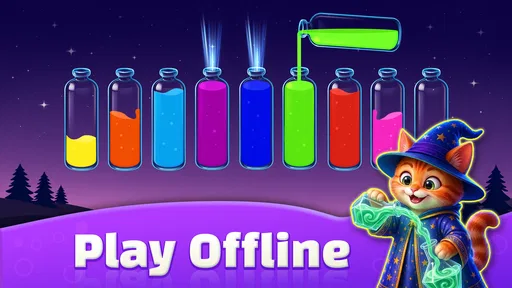
Many of the core sorting puzzles can be played offline after the application has been installed, which makes the game suitable for travel or situations without reliable mobile data. However, features such as advertisements, cloud synchronization, updates, rewards, or analytics may require an internet connection. Offline functionality can vary by version, so it is worth testing the game after disabling Wi-Fi and mobile data.
Are there hints, undo options, or ways to recover from a mistake?
Water Sort: Color Match is designed around planning each pour, but mistakes are usually manageable through features such as undo, restarting a level, or using a hint, depending on the version and level. Some assistance may be limited, earned through gameplay, or connected to advertisements. Before making a difficult move, consider whether an empty bottle is needed later, since careless pouring can quickly block the solution.
Is Water Sort: Color Match suitable for children and casual players?
The game is easy to understand and does not require fast reactions, making it appropriate for casual players and many children. It can encourage visual organization, concentration, and basic problem-solving. Nevertheless, parents should review the app’s age rating, advertising, privacy information, and any in-app purchases before allowing younger children to play. Difficulty may increase significantly, so some levels could require patience or occasional assistance.
Play our best games!


